

Targeted cancer treatment helps Georgia boy facing advanced neuroblastoma

Personalized treatment saves child from cancer
Children's Healthcare launched its Precision Medicine Program the same year that Edward Page was diagnosed with cancer: 2017. Doctors said that unique treatment plan saved his life. FOX Medical Team's Beth Galvin heard his incredible story.
ATLANTA - When Edward Page got sick back in the fall of 2017, his parents, Jinnie and Andrew say things unraveled quickly.
"He'd had about a month of random fevers, abdominal pain, some weight loss," Jinnie Page remembers.
They took him to the pediatrician three or four times.
Then, on November 4, 2017, during a soccer match, his parents realized something was very wrong.
"He just didn't look right," Andrew Page says. "He literally sat down while he was playing soccer, and we knew something wasn't right."
The Pages, both doctors, brought Edward to the emergency department at Children's Healthcare of Atlanta, where they were stunned to learn he had a mass in his abdomen.
He was diagnosed with metastatic, or advanced, neuroblastoma.
Andrew, a cancer surgeon and Jennie, a plastic surgeon, braced for the worst.
"I felt like I knew too much," he says. "When they did the first set of scans, I couldn't look at them."
In medical school, Jennie Page remembered the survival rate for Edward's type of cancer was about 10 to 15%.
"Having that background, and going into this diagnosis, our world ended right there," she says.
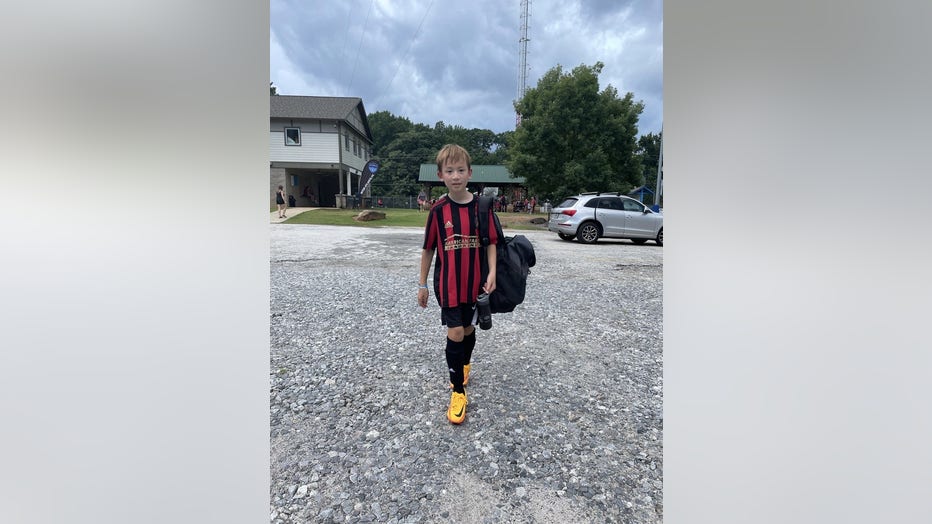
Edward Page, 9, is a survivor of metastatic neuroblastoma.
But Dr. Kelly Goldsmith, the clinical director of the Aflac Cancer and Blood Disorder Center's Precision Medicine program at Children's reassured the Pages, while this cancer was aggressive, children often experience cancer differently than adults.
"Pediatric cancer can be curable, and it's very different," Dr. Goldsmith told them. "Kids are resilient."
The next year and a half was grueling for Edward and his family.
"To treat neuroblastoma, you need a lot of tools," Andrew Page says. "You need surgery, you need chemotherapy, you need bone marrow transplant."
However, when a stubborn spot in Edward's chest would not respond to standard treatment, the Pages finally got a break.
Surgeons took out a sample of the tumor, and Goldsmith and the precision medicine team genetically sequenced it.
That is when they discovered a gene mutation they could target with a newer drug, that would hone on Edward's cancer cells without destroying his healthy cells.
"We have come incredibly far," Dr. Goldsmith says.
With $10 million dollars in funding from the Atlanta non-profit CURE Childhood Cancer, Children's Healthcare is able to offer kids with rare, difficult to treat or recurring cancers genetic sequencing to better understand what might be driving their cancers, and how to treat them better.
For about 80% of those children, CURE CEO Kristin Connor says, the sequencing yields helpful clues about their cancer.
"They learn information about the genetic drivers of their cancer, which impacts their treatment," Connor says. "So, 80% is a big number. So, we're really proud to have changed the care for children with cancer here in Georgia."
Today, Edward Page is in the fourth grade, and thriving.
"These are the success stories that we live for," Dr. Goldsmith says. "These are the success stories that keep us going."
His cancer has been in remission for two and a half years, and counting.
"He loves animals and plants," Jennie Page says. "He'll fall asleep reading his plant encyclopedia. The boy has so much passion for life and is into everything."